The Steampunk Workshop

Home

  • Home
  • Projects
  • Feature Articles
  • Steampunk Labs Projects
    • Gas Mask Sawdust Respirator
    • How to Make a Cheap Lightbox
    • How to Make a Large Flash Diffuser
    • Thoughts on Building a Steam Car
    • Toner Transfer Fuser
  • Kerosene Lamp Projects
  • Ephemera
  • Books & Reviews
  • Events
  • Upcycling:
  • Music
  • Steampunk Links
  • Technical Resources - Links
  • Site Search
  • Foundry Furnace - Part 1

How to Make a Cheap Lightbox

Jake von Slatt — Thu, 02/15/2007 - 01:00

For many of my recent projects I have found myself in need of a lightbox so I took a couple of hours from working on my latest project to put together this one.  I used a piece of glass from the old Xerox machine that I bought for ten dollars a few weeks ago.   The glass is 14 3/4" by 18".  Any piece of clear material will do, but the glass from a copier is ideal because it's tempered safety glass.  A flat piece of automotive glass would be an equally good choice.  If you do use regular widow glass keep your lightbox on the small side to help reduce the chance of breakage.

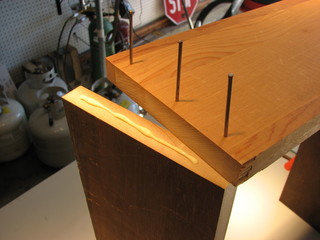
After choosing the glass, I measured and cut some wood scraps to form the box.  I used a very simple construction method, just a bit of glue and some nails.
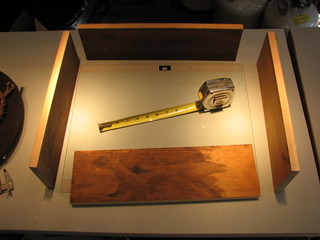
cutting wood for the lightboxgluing and nailing the box

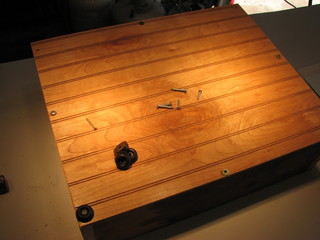
I made a bottom piece from a scrap of paneling.  I drilled eight holes and attached it with sheet metal screws.  Using screws is important because the glass will be glued on so any future repair that may be required will need to be performed from below.

I installed 3/8" high rubber feet at each corner to raise the box off of the table top.  This is important because I plan to drill vent hole in the bottom.

wooden box bottomscrewing the lightbox bottom on

Next I painted the inside of the box with white primer.
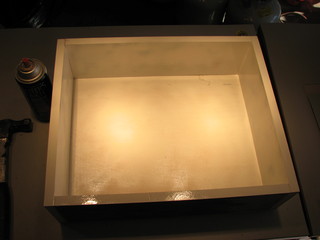
painting the inside of the lightbox

Compact fluorescent light bulbs are perfect for this application because they produce little heat and a great deal of light.  These are 11 watt bulbs from Ikea.  Once I positioned them I drilled (3) 1/2" holes directly under the tubes.
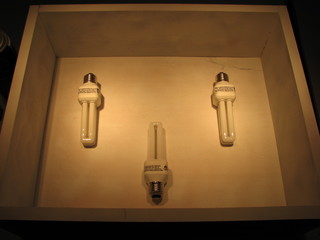
lightbox compact flourescent bulbslightbox vent holes

I used sockets salvaged from the light fixtures I stripped to make some of my kerosene lamps.  I glued the bulbs down with polyurethane construction adhesive and then tacked them in place with some hot glue because the polyurethane needs several hours to cure.

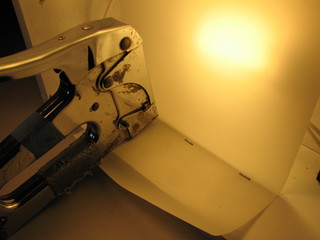
To further diffuse the light I installed a strip of drafting acetate across the lights about 3" from where the glass will be.  Charette or an art and/or drafting supply house will have acetate.
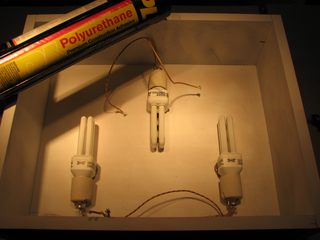
glueing down the CF bulbsinstalling acetate

I glued in a toggle switch and wired the lights with a pair of quick disconnects so I can remove the bottom for servicing.  The only thing you really have to be aware of when wiring is that the ridged wire in the line cord needs to connect to the white wire from the sockets, this is the "Neutral".  The smooth wire in the cord connects to the wires with the black stripe (or they may be solid black on your sockets) this is the "Hot" or "Line".
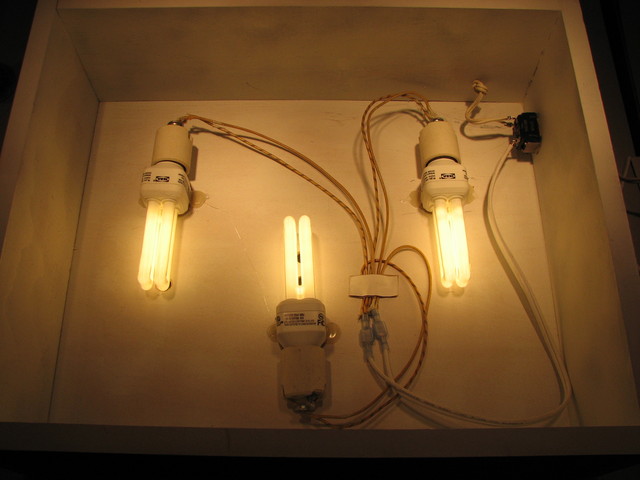
wiring the lightbox

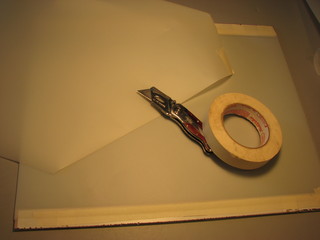
Here is the lightbox with the acetate strip in place and holes drilled in the back for ventilation.  Next step was to tape more acetate to the back of the piece of glass.,  The copier glass had a nice painted area at the top and  bottom to hide the ugly masking tape, you may want to paint something similar on yours.  I glued the glass to the top of the box with G.E. Silicon II WIndow and Door Sealant.
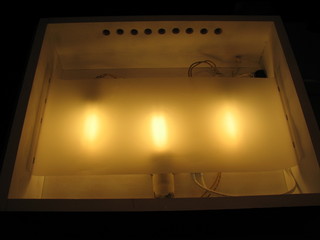
lighbox acetate and rear vent holeslightbox top

The lighted area of the completed box.  You can see that there are bright spots above the bulbs, but the surface is actually quite evenly illuminated.
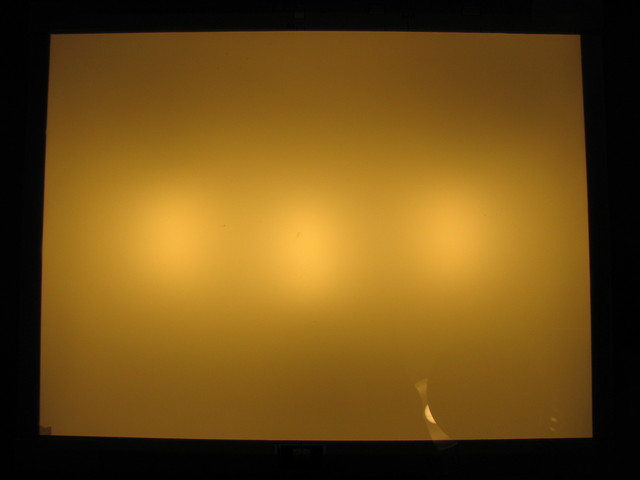
even illumination

It works quite well as a lightbox and I'm sure it will be very handy.  
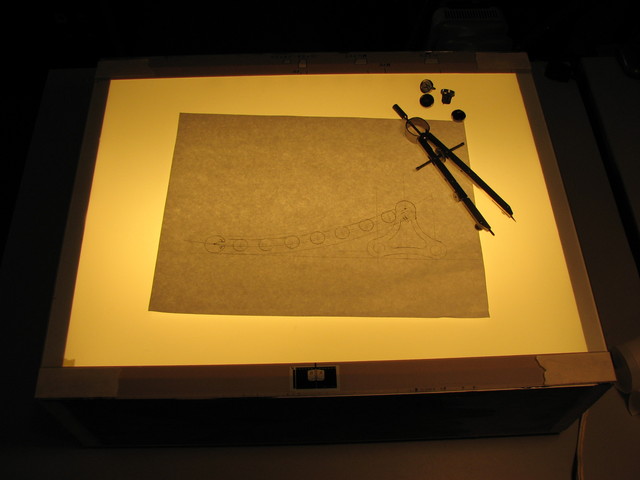
lightbox


  • Art
  • Jake von Slatt
  • Labs Projects
  • Projects
  • Tools
  • Login or register to post comments

Light temperature in ºK

Fernando Gonzal... — Sun, 06/14/2009 - 01:41

I was just about to build one, but more compact in size.

I stopped when I couldn't solve the question if I should use cool-daylight lamps or warm light lamps. Cool daylight are 6500ºK, same as my monitor's white point - while warm ones are around 5000ºK, not sure about this last.

I shall use it only for viewing 135mm daylight color slide film, so as to adjust levels and curves and brightness in the scanner software or when making corrections at post-processing.

Advice welcome !

Fernando.

  • Login or register to post comments

 LOL! as you can tell by my

Jake von Slatt — Sun, 06/14/2009 - 10:17

 LOL! as you can tell by my photos I did not know a whole lot about "White Balance" when I took these shots!  The bulbs I used are of the warm white variety and to get a decent image I should have set my camera on "Tungsten" or used the custom white balance setting.

But since I was mainly interested in using the box for tracing rather than examining slide, the issue of color temperature never came to mind.

There are some CF bulbs that are made for photography and have a 5500K color temperature like this one: 

http://www.calumetphoto.com/item/ol2003/

They are a bit pricey at $20 each but if color is important, they are the way to go.


  • Login or register to post comments

CFL's are great

t0cableguy — Tue, 06/23/2009 - 03:35

If you know of a good local electrical supply shop that doesnt gouge its non commercial customers you can actually order the bulbs by the Kelvin range.
And.. if you're using CFL's for color correction, make sure you give them a minute to warm up, they tend to be dim when they're first turned on.

  • Login or register to post comments

lightbox

bitsandbitsy1 — Mon, 03/09/2009 - 13:11

hi, great tutorial.

Im looking to create something similar for my catering trailer. It would be a menu display box, including graphics etc, however I am a complete novice with this type of thing. Would you be able to show me how the wiring of the lights are done, and is there anyway to have it powered by batteries rather than the mains, if so how?
Would I also be able to make the box thinner without burning down my business? :)

Any help is appreciated.

Thanks, and keep up the good work.

  • Login or register to post comments

You may do well using 12v low

t0cableguy — Tue, 06/23/2009 - 03:53

You may do well using 12v low voltage track lighting... the kits are getting cheap now and you can do away with the transformer and connect it directly to your 12v battery source. maybe lighting it from in front, instead of backlighting it? you could make it chalkboard or wood, or whatever, even go for the steampunk look?

  • Login or register to post comments

Brightness

3163349 (not verified) — Wed, 04/09/2008 - 19:21

Hi, i'm in the process of building my own lightboxes. Was just wondering if you think 3 x 11W bulbs provide sufficient illumination to use the lightbox without having to go into a dimmed room.

Or whether i should up mine to the 15W bulbs?

  • Login or register to post comments

I think it all depends on the

Jake von Slatt — Thu, 04/10/2008 - 08:55

I think it all depends on the media you're using.  My photography here is rather less then ideal, the box is brighter then it appears.  Oh! do increase the ventilation if you increase the size of the bulb, more wattage means more heat.

  • Login or register to post comments

Transparency Film

3163349 (not verified) — Sat, 04/12/2008 - 13:01

I'm planning on mounting transparency film onto them, then mounting on the wall. So hopefully most of the heat will rise out of the box and not melt the film.

I'll keep you posted on the happenings, if your interested!

  • Login or register to post comments

Transparencies need relatively little light

steviesteveo — Tue, 01/20/2009 - 07:55

You don't need to blow out the viewer's eyes to light a transparency, you need enough to make the white sections white but you should also avoid going too far and making the black sections brown. Also remember that the visual impact of your transparency display is greatly lessened if your viewer is squinting at it because of the lightbox.

Too dim is terrible for transparencies but too bright is equally unfortunate. That said, modern film is quite resilient to heat (it's been a long time since people have had film melt in their camera) and you rarely need to go as far as anything like cooling equipment.

  • Login or register to post comments

CFL's

t0cableguy — Tue, 06/23/2009 - 03:41

I'd worry more about the cfl's burning up than anything. Make sure you have some sort of air flow for them. Most CFL's are rated to be in a fixture with an open top, to provide cooling. Believe it or not these bulbs do get hot, although not as hot as a regular incandescent of the same output.

  • Login or register to post comments

Search


Projects:

Keyboard
Altoids Tin Etching
Lightbox
Lyra's Lamp
Shop Respirator
Etching Brass
Flash Diffuser
Light Switch Plates

Bus Conversion

All-in-One PC

LCD Monitor

Motorbike

MAC Mini Mod

Etch Machining

iPod Etch

Headphone Mod

Steampunk Strat

Telegraph Build

Steampunk Car

Trilobite Etch

Kerosene Lamps

Trailer


Login

What is OpenID?
  • Log in using OpenID
  • Cancel OpenID login
  • Create new account
  • Request new password

Subscribe

Subscribe to our Announcement List:

Your email will never be divulged and we will only make an announcement when there is a genuinely interesting new thing.