Home

Twitter

Related Stories:

Toner Transfer Fuser
Copper Plating and Etching Altoids Tins
Technical Links
Electrolytic Machining of Brass - Part II:
Electrolytic Machining of Brass, a Clockwork Trilobite
Etching Brass - Mailbag
Jake's Hollywood Adventure and Etching an iPod

Electrolytic Etching of Brass

Jake von Slatt — Wed, 01/10/2007 - 06:07


Update: I'm often asked about the thickness, type, and source of brass I used for these journals.  I am very lucky to have a local place, Metal Source, were I buy most of my supplies.  I used 22 ga. (.025") brass and any alloy will do.  In a pinch you can buy brass door kick plates at your local home center, but you will need to strip the lacquer.  If you can't find any local source you can buy online, but this is the most expensive option.


A while ago I saw Mark Frauenfelder's limited edition Moleskin notebooks on BoingBoing and immediately thought of using the electrolytic brass etching process that I've been experimenting with to make some similar notebooks to give as gifts this year.


As you can see they came out quite well and the Moleskin's two century history lends the project a certain Steampunk street cred.
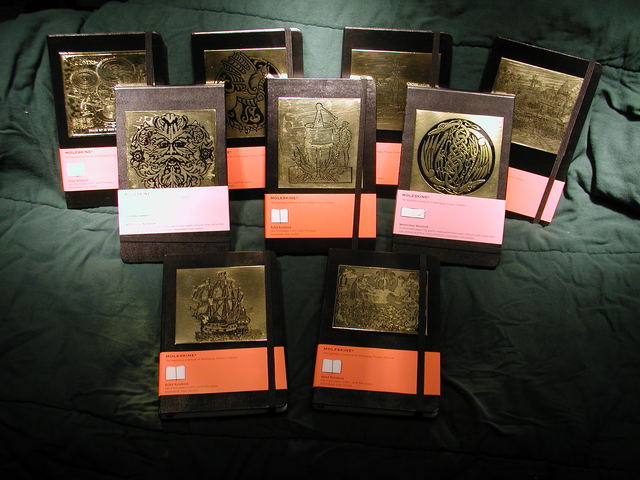
moleskin notebook with etched brass plate

This is a technique I adapted for easily impressing images into brass plate. I say "impressing" but what I'm actually doing is electro-chemically etching the brass.  Here's the process:

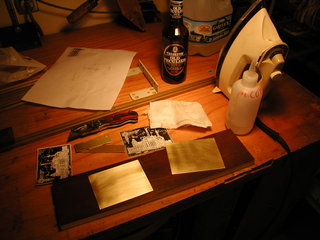
First we use a laser printer to print a negative of our image onto a sheet of inkjet glossy photo paper.  Yes, I did say inkjet paper, this is an "off schedule," use as they say in the pharmaceutical biz.

Next we throughly clean a piece of brass with Scotch Bright and then scrub it with alcohol until it's completely clean.  Several alcohol scrubbings will be needed to remove all of the dirt.
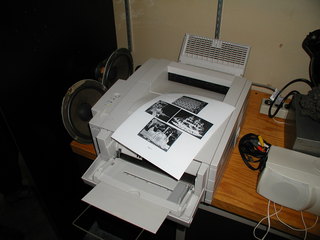
laser print toner mask  clean the brass plate

Next we use an iron set to it's highest setting to melt the toner onto the brass plate.  Press hard on the iron and move it around a bit.  I used the roller pictured to further press the paper against the brass.  Total heating and rollering time was about 2 minutes.

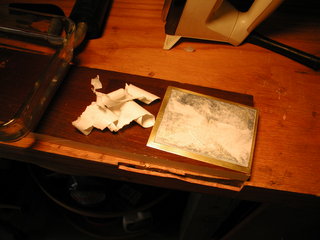
Once you are satisfied that the toner has been completely melted onto the brass, drop the plate into a tray of hot water.  The water soak is intended to soften the inkjet photo paper backing so that it can be peeled away from the toner now stuck to the brass.
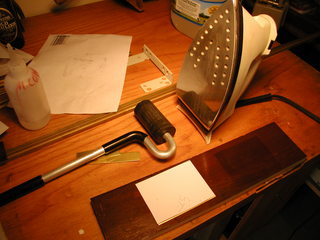
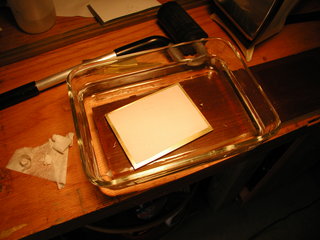
iron toner onto plate  soak brass plate in tray

This is actually a technique that has been developed by hobbyists for making electronic printed circuit boards.  Please see the bibliography below for the source and for more detailed information on this part of the process.

Once the board has soaked for 5-10 minutes, take it out and gently try and peel back some of the now softened paper.  After peeling off a layer, return it to the water.
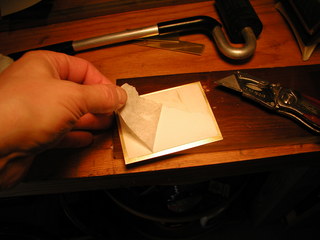
peel off paper layer by layer  peel paper to expose toner

Once you get most of the paper off you can us a stiff brush to remove the remainder.  You want nothing left but bare brass and toner.
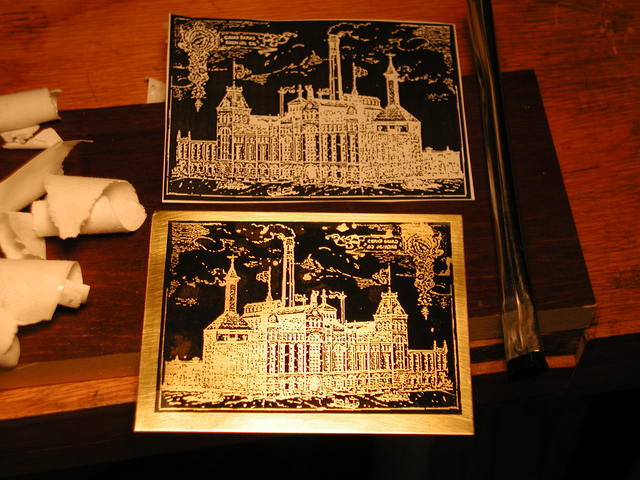
 brass plate with toner

Now we come to the neat 19th Century technique called Galvanic Etching.  You may be familiar with the technique of electro-plating, where a metal object is plated with a layer of another metal by placing it in a bath with a source of plating metal and running current through it.  

This is exactly the same thing except we connect our piece to the positive terminal because we desire to remove material from it.  This technique was developed in the 19th Century for creating etchings and is still in use today.  Again, please see the bibliography for resources.
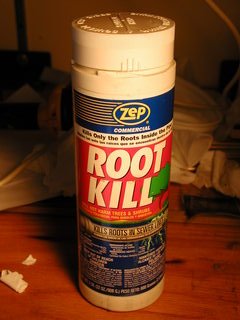
root kill copper sulfate  brass plate holder

My research indicated that a copper sulfate solution could be used for etching both copper and zinc plates.  Since I wanted to etch brass and brass is an alloy of copper and zinc, this should be the right solution for this project.

A little poking around in the garage and I found this container of "Root Kill" which is essentially all copper sulfate.  I mixed about a pound of "Root Kill" into the water you see below. All of it dissolved so I probably could have mixed in a bit more. According to the sites I found, the more saturated the solution the faster the etch.

I made the holders for the brass plates out of brazing rod.  I was aware that brazing rod is typically bronze and was hoping that the tin wouldn't mess things up.
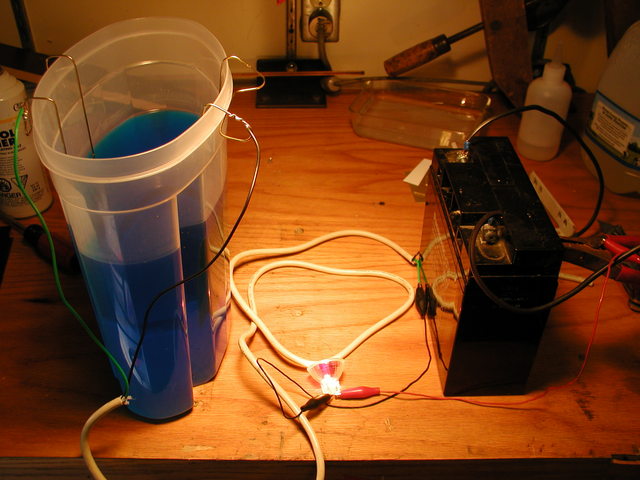
electrolyte bath and battery

The work piece is connected the the positive side of the battery.  I used a 12 volt 17 amp hour lead acid gel cell, but a car battery, battery charger, or modified PC power supply will also work.  A lamp in series can be used to limit the current flowing through the electrolyte but I found that for the electrolyte I was using and the size of my plates it was not needed.  Also, since I want a deep bite into the brass, I don't really need to be gentle.

etching plate in copper sulfate solution

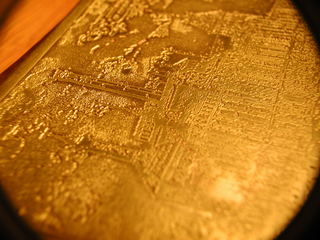
After a minute or so nothing much was happening, though a brownish residue was forming on the work.  I removed the light bulb from the circuit and moved the plates closer together.  At this point the 16 gauge power cord I was using started to get warm and I could see the less dense hot water rising around the plates in the bath.  I estimate that the current was between 10 and 20 amps.  There were surprisingly few bubbles.

moving plates closer to increase amperage  close up of etched plate

At this point things started happening more quickly.  I took the plate out of the bath about every 15 minutes and brushed the brownish crud off.  After about 45 minutes in the bath I noticed that some of the toner came off while brushing, so I took the plate out and rinsed it well.  I used paint stripper to remove the toner but in another test I used steel wool under running water and that worked just as well.
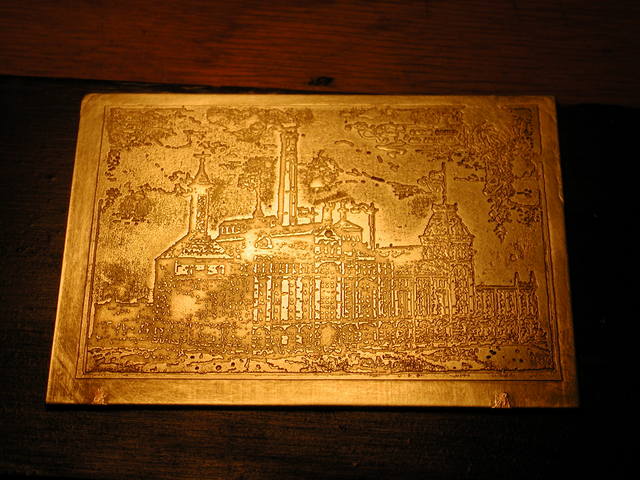
electo-etched brass plate

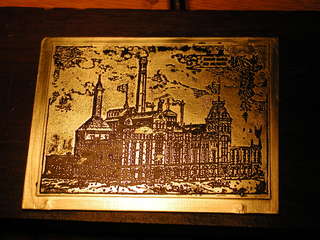
Here is the finished plate, I estimate the bath etched down about .5 mm into the brass.  The material removal is very consistent and the lines where the toner was are sharp and clear.
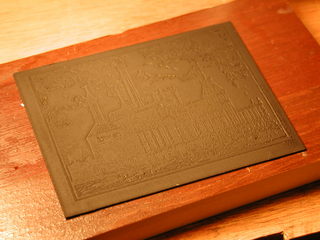
brass plate with primer  primer removed from relief

I sprayed the plate with black primer, let it dry, and used sand paper and Scotch Bright to remove the primer from the high spots. Finally, I polished it with some Noxon Metal Polish.
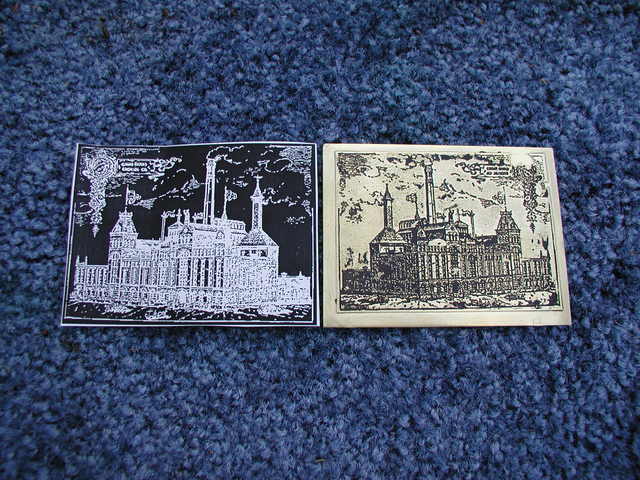
etched plate and nagative

Here's a shot of the finished plate compared with the laser printed negative, you can see that the image is reproduced in the brass almost perfectly.  

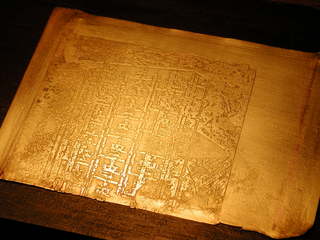
Below is another test plate that I made earlier, you can see that the lower right sword hilt is missing.  This part of the image had been drawn in with a Sharpie and the ink apparently did not hold up to the solution.  However, on the back you can clearly make out Charles Babbage's Difference Engine.  I had ironed on that toner from a sheet of laser printable overhead film and had rejected it as not leaving a dense enough layer of toner on the brass, perhaps I'll re-visit that technique as it was very easy and fast  and clearly has some efficacy.
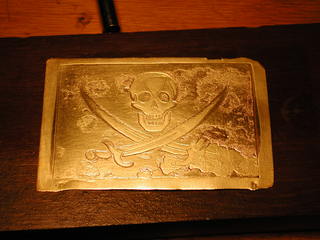
pirate belt buckle  the difference engine

A Note of Warning: There are some elements of this project that are dangerous and which this article does attempt to address in detail.  However, Greenart has extensive information on this process and I urge anyone who plans on trying this to go there, read, and understand the detailed safety and disposal information. In particular you need to read the page on the Bordeaux Etch process as it covers the necessary steps for proper disposal of the spent solution.  - Jake.

Bibliography:

Gootee, Thomas P. Easy Printed Circuit Board Fabrication - Using Laser Printer Toner Transfer, http://www.fullnet.com/u/tomg/gooteepc.htm.

Green, Cedric. Green Prints -Etching without Acid, http://www.greenart.info/galvetch/contfram.htm


  • Art
  • Etching
  • Jake von Slatt
  • Moleskine
  • Projects
  • Steampunk
  • Login or register to post comments

Comment viewing options

Select your preferred way to display the comments and click "Save settings" to activate your changes.

toner transfer alternative

aegisjester — Wed, 12/21/2011 - 01:17

I read up on this a few months ago, and I've done about 5 plate's worth of etching under various conditions to find what worked best for me. I have 6"x12"x.025" brass plates I purchased online from Ace hardware's outlet stores (couldn't find any local retailers), and I have a large shop available for my use on this project.

For supplies I had a office printer/scanner/copier for the office I work at, some 5 gallon buckets, a 24 volt/80 amp car battery charger I used as the power source, but I had no access to photo paper which ran through the copier without jamming and being destroyed.

Everything went smoothly with your method in my application, but I only had regular copier paper instead of the suggested photo paper. However, when I used the method you described for melting the toner onto the plate, it still worked wonderfully. After about 15 minutes of hard pressing, followed by dunking repeatedly in water while I slowly rubbed off the wet paper, I was left with bare brass and toner. There was about 1/15th of my design that did not properly transfer, but I can just as easily attribute this to impatience on my part as to a problem in the methodology, and it was touched up easily enough with a bit of pipe glue (which works well as a mask in and of itself). The part that did not transfer properly was a small square (which did transfer, just not as well as the other areas), otherwise all the lines were crisp and clean after the etching.

I did several different trial runs of toner transfer with just copier paper, and I can say after 15 minutes of hard pressing the results are as perfect as I could hope for. I left the iron sit for a half an hour without pressing to basically no effect, so the pressing, moving, and rolling is really what helps it work.

Just a tip for others who don't have perfect access to supplies.

  • Login or register to post comments

Thanks and Inspiration

MadScienceDesigns — Fri, 12/16/2011 - 09:29

Hi Jake,

First and foremost, your site/blog is spectacular.

I wanted to thank you for the posts on etching and machining using the electrolytic process; not only did it make a great set of gifts for last holiday season (my family being nicely confused at how I made those journals) but it also inspired me to try something a little different.

I used two power sources for my etches: the basic battery setup that you used, which I found drained quickly over the course of the projects I did, and I also converted an old computer power supply into a DC power supply. That drained the house power (and my wallet!) to an alarming degree for just a few etches.

The new idea: human-powered etching! I'm building a stationary bike AC/DC power generator, so I don't have to worry about buying batteries or sapping the power off my home grid.

Just a neat idea I thought I'd share. If it's okay with you, I'd like to post a link to the Kickstarter campaign I have setup to raise funds to build it and my new etching rig. It has pictures of some of my work and design ideas too, and is being subsequently used to launch a Steampunk / Reniassance-style craft start-up.

Either way, your site is awesome. That Steampunk monitor / keyboard are on my To Do list, for sure!

Chris from
Mad Science Designs
Baltimore, MD

  • Login or register to post comments

Two-Tone Etchings / Stepped, Multi-Layer Plating

Tex Pepper — Sun, 09/25/2011 - 23:27

Hello Jake,

Nice work. Very nice indeed!

Jake, I had an idea that I'd like to bounce off you and the group. I've not actually tried this yet myself. What do you think of this variant: etch your pattern into the brass, as before, but then - with the 'mask' still in place - immediately follow the etch with a plating step? And so, rather than using a black fill, as you've done, plate a different-coloured metal (copper or silver) onto the etched surface instead. Depending on the particular design/pattern, I can imagine the result may actually turn out to be quite beautiful.

I should think this process could be extended (at least on paper) to create an arbitrary number of alternating layers of different-coloured metals, each having been deposited with a different 'mask' in place. This process might be used to create, for example, a topographic-map sort of impression where the metal colour changes at each elevation contour, in a manner of speaking. You could do this with or without an initial 3D etch step, depending on your particular objectives.

Or, you could plate the raw material wholesale and then machine it, exposing the different layers at an angle for example.

Have you tried anything like this before? How did it turn out?

Again, lovely work, Jake! And thank you for making all this remarkable fare available online.

Blessings to you and yours,
Tex

  • Login or register to post comments

That's essentially what I did

Jake von Slatt — Mon, 09/26/2011 - 08:37

That's essentially what I did here: http://steampunkworkshop.com/etching-tins-salt-water-and-electricity-compliment-steampunk-bible-article

I copper plated the tins while the mask was stil on.

  • Login or register to post comments

Transfer Paper

woodnut — Sat, 08/13/2011 - 11:10

New transfer paper for etching.

Shelf liner, yes shelf liner from WalMart. I got a 20” x 18’ roll for $10.
I was playing around with sand blasting using shelf liner as a mask. I would print my design on to it and cut out the pattern. I noticed that the toner would flake off the liner when I cut it. So why not try it with metal etching. I printed the pattern backwards, clean up the copper plate, heated up the copper plate with the iron first! This made the liner paper stick to the copper and not move around. Using an old piece of ABS pipe I slowly rolled out the transfer paper onto the copper trying to get all the bubbles out. I then put a piece of copy paper on top of the liner paper and then ironed the piece. Stopping every 30 seconds to roll the piece with the ABS pipe. Careful as you can melt the liner paper. I heated for 30 seconds on high then rolled, did this 3 times, the last time I noticed the back of the liner paper melting a bit and sticking to the ABS pipe. I removed the liner paper right away. Best part, only the toner transferred! No paper or other parts transferred to the copper plate! Just the toner.
My first piece is picture of my son in a plane at the War Museum. I turned it into a halftone pattern using Photoshop. It’s been in the bath for 20 minutes now and so far the toner is holding up great.
I got impatient after 25 minutes I took it out and cleaned off the toner, which was still in good shape. I should of left it in the bath for another 20 minutes or so. Got a half descend etch, you can feel it easily with our finger. Will have to play around with the halftone settings to get a better picture. So far this looks promising. Will try doing a line art next to see how large areas transfer.

  • Login or register to post comments

Thank you ! That's great

Jake von Slatt — Sat, 08/13/2011 - 11:21

Thank you ! That's great information!  

  • Login or register to post comments

No Problem,

woodnut — Sat, 08/13/2011 - 11:58

Here's another use.

If your design is not to complicated then you can print the design on to the shelf liner paper, peal the backing and attached the paper to the piece and then cut it out. The liner paper is unaffected by the solution so very long etching baths can be done. Here is a link to a piece I did in 3/8” 8”x8” metal plate.

http://browse.deviantart.com/artisan/metalwork/?order=5&offset=168#/d461h63

The piece was sandblasted after the design was cut out of the mask (to clean it up), then it sat in the bath for about 2 hrs, my battery charger kept over heating and turning off so I am not sure on the total time. Even after sandblasting the shelf liner was still in great shape after the bath.

If your design has some smaller parts, I found heating up the piece with a heat gun on low helps re-stick the shelf liner back to the piece and acetone remove any glue afterwards.

Hope this helps.

  • Login or register to post comments

Etching projects

sjg41669 — Mon, 07/18/2011 - 17:28

As this site was the source of information I used to start etching things, I thought I'd share some of the results.

This is a headphone amplifier enclosure that I etched using saltwater. This particular etch ran for 4 minutes which was just a bit too long. The original Altoids tin has also been coated with copper using a copper sulfate solution
http://dl.dropbox.com/u/7175635/Etched%20headphone%20amplifier.JPG

This is a storage tin I made for guitar picks. The top plate is copper, and was etched in copper sulfate for 45 minutes. Again the the Altoids tin was coated using the copper sulfate solution.
http://dl.dropbox.com/u/7175635/Guitar%20pick%20tin.JPG

This is a journal that I bound and in the cover is an inset etching of Cthulhu.
http://dl.dropbox.com/u/7175635/Bound%20journal%20with%20etched%20cover%20plate.JPG

All things considered it's a pretty easy process and it does allow you to quickly make unique and customized items.

  • Login or register to post comments

Had to give this a try!

gscsderby — Sat, 05/21/2011 - 21:49

I came across your site while researching ways to rebuild and/or repurpose old lamps and was truly impressed by the wealth of information it contains. I have always had an affinity with/for older tech, as well as an appreciation for the elegance (despite the functionality) of the Victorian era, however I had never even heard of "Steampunk".

The concept of etching brass plates for your Molskine project struck a chord for me. It balances well with my interest in the Heraldic arts, love of reading (including the use of old fashioned Bookplates; Ex Libras, et al), and any reason to spend time in the garage tinkering. With that said, I had to spend my first efforts creating designs along the aforementioned lines and, thus attempted to create a couple of Bookplates for the e-book device (Sony Reader & Kindle) covers that my daughters have.

Attempt #1 started with a 3.5”W x 18”L brass door kickplate as my plate source metal. I attempted to strip the clear-coat from the plate but either didn’t wait long enough for the chemical stripper to bite or didn’t apply the appropriate quantity of #1 elbow grease. These errors, and my lack of a handy power source, resulted in my first batch of toner transfers being wasted as the entire piece was still impervious to the etchant!

I have decided that when faced with such dilemmas the need for perseverance becomes paramount!

Attempt #2 utilized the same plates created for attempt #1; however the prep work required the complete removal of the original resist. Several passes with a green scrubby and some 600 grit wet/dry paper created a properly de-nuded etching surface. Reapplication of the inverted, mirrored resist images was conducted utilizing a RC Plane builder’s hobby iron that I picked up 10-12 years ago for a well procrastinated project (read, never completed).

Since I don’t have a power source, as mentioned, I was forced to be content with the results only time and chemicals could provide. Each plate was soaked in a chemical bath solution made up of two-parts Peroxide and one-part Muriatic acid for periods of up to 2-hours. I was really surprised and elated at the level of detail I was able to achieve with this process and, if I can ever figure out how to add photos here, I will share my results!

Once satisfied with the depth of the etching, I rinsed the plates in cold water and allowed them to dry. I then painted the entire surface with flat black enamel spray paint and let that dry. After the paint dried, I used more of the 600 grit wet/dry paper and a stream of mildly hot water to remove paint from the unwanted areas.

…Note to self… use ridged (glass/granite) sanding block next time to prevent removal of paint from low areas!

All in all, I am really very satisfied and impressed with the results of my first attempt using these processes.

Thanks Jake, for re-introducing me to the wonders of what can be created in my own garage/tinkerers barn!

  • Login or register to post comments

Gotta ask

Zclip — Wed, 05/18/2011 - 21:44

When you wrote about using a "12 volt 17 amp hour lead acid gel cell" to get "a deep bite into the brass", If you are working with, say 20 or 18 Guage plate, and you wanted the etch very deep or even all the way through, do you know of a way to protect the image quality from being "side eaten" as the etch gets deeper into the plate? Thanks man.

  • Login or register to post comments

Where's "local"? My guy here

Bill Eccles — Fri, 04/01/2011 - 14:59

Where's "local"? My guy here in CT says they've stopped importing it into the US (according to his distributor) and there are several of us who would gladly venture to "local" to pick some up!

  • Login or register to post comments

Your process with quite a few deviations

Bromic — Thu, 03/10/2011 - 00:00

While trying to come up with an idea for a marquee for my MAME I ran across this procedure and thought wouldn't it be awesome to have a brass sign to go on top of it. So I got my brass and my copper sulfate and did some proof of concept experiments just using clear tape as my material to prevent electrolysis. Etching did occur however I essentially just want a black background and when I tried to paint the brass black and sand off the 'high' areas it inevitably ended up sanding off plenty of low areas too since the high areas were few and far between (and since I was using really thin brass the low areas were not all that low).

Next up I tried reversing the electrodes to plate out copper on my etched brass, the reasoning being that the copper should hold better to the etched surface. That was the case and using some Brasso I was able to polish the copper to give a really neat effect. Still, I didn't have the contrast I needed.

Finally I thought of tarnishing the copper since it tarnishes easier than brass so I made up some liver of sulfur and applied. The copper immediately turned black and the brass stayed pretty much looking like brass. If I leave the tape or the ink from the laserjet printer in place it should protect the brass so the brass stays looking completely like brass. Still, this gave beautiful results and the copper was plenty thick and strong enough to be modified in this way.

My small scale proof of concept looks fine so I'll be scaling this up to the full sized marquee after another go. Thanks again!

I'm going to try to insert a picture here of the work in progress. The copper layer needs to be ever so slightly thicker as you can see where I rubbed it off and the 'black' didn't take hold but otherwise it's perfect.

  • Login or register to post comments

Thanks for the update! That's

Jake von Slatt — Thu, 03/10/2011 - 10:13

Thanks for the update! That's a very cool idea and great results!

Jake.

  • Login or register to post comments

More mundane question: Where'd you get the "Old Peculiar"?!

Bill Eccles — Tue, 03/08/2011 - 11:16

I can't find it in Connecticut… sigh...

  • Login or register to post comments

Our local packy has it here

Jake von Slatt — Fri, 03/18/2011 - 06:27

Our local packy has it here in Mass, they have a whole wall of "world beer!"


(Note: "packy" in MA is slang for "Package Store," a liquor store.)

  • Login or register to post comments

My insights & results

exroadie — Fri, 12/17/2010 - 00:04

Since first reading this post years ago, I've been working to perfect this process. Here are some insights I've learned (mostly the hard way), and results.

- For brass stock, I buy brass door kick plates from the local home improvement store (I haven't found another local source, and while there are web sites you can order from, shipping brass can be pricey). I etch the image on the back side of the kick plate - it is easier to clean. I clean the brass with a sanding wheel on an old hand drill, with some water to keep the dust down. I remove all of the finish, until I only see brushed brass. Takes a few minutes. Clean with a little bit of soap and water, rinse very very well, and then clean again with some denatured alcohol. I immediately wrap in brass in a clean lint free cloth. Dust particles are not your friend.

- I use the press & peel blue paper printed on a b/w HP-1000 laser printer. It works well, but can be finicky.(I create the images using photoshop/publisher)

- When transferring the image, again, dust is your enemy. Before you iron, make sure the brass and paper are dust/lint/hair/dog/cat fur free. I set my crappy old iron on about 85% heat. I also have a tapered wooden pie roller, and an old but heavy flat iron I use to work the impression onto the brass. Hot iron - roller - hot iron - roller, etc. for about 5 minutes. When I'm ironing, I'll often use some hand clamps to hold my iron down to the brass plate for a minute or two. Don't quench the plate, let it cool at room temperature for about 5-10 minutes until it is cool to the touch, then carefully peel off the paper. I tend to start in a corner, and slowly roll the paper tightly backwards as I remove it, keeping some pressure on the paper/plate. I use a sharpie (multiple coats) to touch-up areas as necessary.

- My power source for the etch is an old car battery. I have a trickle charger to keep it ready for the next project. I'm looking into upgrade options here..perhaps a regulated high amperage DC power source?

- I'll keep the etch going as long as the ink stays in place. As soon as it starts to look like it's about to flake off, it's time to stop. Usually about 45 minutes. I get about a 0.5mm - 0.75mm deep etch from this process. If I let it go too long, even without flaking, there will be pinholes/pitting.

-Getting the ink off can be a pain. I use a teaspoon of paint remover.

-For finishing, I spray with a primer (usually brown, but black works too). Enamels are hard to remove. Don't let the paint sit too long. It can't be tacky at all, but the minute it is dry, it's go time. The dryer it is, the harder it is to remove. I use scotchbrite pads and a lot of elbow grease. Don't press too hard, though, or the paint from the finer details of the etching will come out. Sand across lines, not with them, When I'm satisified, I'll let it sit for 12-18 hours for the paint to cure. Then a quick polish with Brasso, and 2 light coats of clear spray paint to finish. Dry for 24 hrs+ before touching. A fingerprint can ruin hours of work.

To date I've made a number of journals like those in this post (they make GREAT gifts), some keychains, and a hundreds of refrigerator magnets for a few local organizations. (Not to mention a pile of mistake brass waiting to to go the recyclers.)

Here is my latest result: http://redditgifts.com/gallery/gift/moleskine-sketchbook-plate-sacred-heart/ (this was for a worldwide secret santa I took part in...the image pixelated a little more than I would have liked, but I was under a time crunch)

Thanks, Jake, for turning me onto this fun hobby. I've gotten many, many hours of satisfying shop time out of this one, and made some very beautiful pieces.

  • Login or register to post comments

Printing a negative

captrick — Thu, 12/02/2010 - 22:12

I have a Brother HL-2170 and can't figure out how to print the negative you refer to in your process of brass etching. Any help would be greatly appreciated.
Thanks

  • Login or register to post comments

Illustrations

anotherescape — Sun, 09/05/2010 - 21:29

I understand, these journals were done a very long time ago, but is there any way you could point me in the right direction to get the illustrations you used.

I especially admire the ship, the bearded man, and the skull.

This is my first comment, but I am a long time admirer, I look forwards to you're next projects.

Thank You

  • Login or register to post comments

RE:Illustrations

exroadie — Fri, 12/17/2010 - 00:59

Use Google image search. Select B/W images. Search for things like etch, etching, woodcut. There are tons of great images out there; half the fun is finding them.

  • Login or register to post comments

bronze rods

Andrew Lind — Fri, 09/03/2010 - 19:44

Amazing stuff!
just a quick question how did you stop the bronze rods from being eaten away as well as the brass plate or was this not a problem?

  • Login or register to post comments

Yeah, the rods eat away

exroadie — Fri, 12/17/2010 - 00:46

I've done a lot of etching, and eventually the rods do eat away. The first rods I made were J-shaped to hold the plate being etched, and I now have two of the finest brass toothpicks you've ever seen. I do enough etching that I now cover the exposed brass with some duct tape, but if you are just doing this now & then it won't be a problem. (As a side note, I don't use rods anymore...I just cut 1" strips of the same material I'm using for the etching, and bend them to shape. I duct tape the plate being etched to the curved hanger)

  • Login or register to post comments

pretty happy paper

pbnj — Wed, 07/21/2010 - 19:13

it is $1.20 a sheet, but it seemed to work very well. Avail at my local JoAnn Fabric store. (the one in Chicago is right next to Micro Center Computer store, so I could maybe say I got lost if anyone I knew saw me there).

It took a lot of ironing with pressure, and I actually heated up an old frying pan and set it on the paper for about 5 rounds. The paper turns brown as it singes, but it does just melt away in water.

Dritz Quilting Wash Away Foundation paper UPC 072879031904
http://www.dritz.com/brands/showcase/details.php?ITEM_NUM=3190

  • Login or register to post comments

Here is another interesting

Jake von Slatt — Fri, 02/19/2010 - 11:00

Here is another interesting technique for toner transfer!

  • Login or register to post comments

etching questions

buffinfun — Mon, 02/22/2010 - 07:23

etched 1st plate 2-21-10...heres my process plus results
cleaned all plates with 220 buff wheel...both sides..ironed on ink jet transfer sample from local print shop on glossy paper 10 cents ea...had 2 papers ist (im guessing) was to thick(the paper)....toner only stuck 30-40%.second paper thinner stuck 98% ironed 10 mins plus also ironed back side of plate second time to get plate hot all the way through....had to leave paper in hot water a long time 1/2 hr plus to get it to fall off and leave toner on ......very tricky
it was 30 deg-f - out side so i used hot water 100 deg-f ...and set my etch tank inside a bucket of hot water 100 deg-f also ...i put a thermometer in side bucket to check temp /stayed 80 deg for 1 hr out side
set up my tank with all brass so i woulnd contaminate with any other metals.i covered back of both plates with electical tape to concetrate etch to fronts of both ...i used 2-3 cups of copper sulphate to 2/3 gallon of water
i have a rectifier so i was hitting 8-9 amps after 15 mins alot of sludge i brushed off lightly with soft paint brush,,,,30 mins more sludge ...brushed off...50-60 mins toner was coming off had to stop ...cleaned plate off had very deep etch ...aprx .08...looked kinda pitted have to fine tune the process almost burnt through the entire plate....was using .19 gauge brass
thanks again...... buffinfun@yahoo.com

  • Login or register to post comments

Thanks

michaelaly — Wed, 12/23/2009 - 09:45

Thanks for posting this information, as well as the link to GreenArt. My first try wasn't exactly pretty but I learned a lot, and I did get an etch using a car battery charger. I deviated from your instructions in 2 places. 1 ) I used a toner print on a transparency instead of inkjet paper. I don't have a laser printer so couldn't use inkjet paper, and using the paper from the print shop failed miserably. 2) I found a 5lb bag of pure copper sulphate in a local gardening store, it's used to control algae growth in ponds so anywhere they sell aquatic chemicals you can probably find copper sulphate. The placement of the negative wire makes a difference. I only used one wire, suspended laterally across the rectangular plate, and as a result the etch is a bit uneven. I plan to use a grid in the future as suggested on GreenArt. I also didn't get a very deep bite after 45 minutes of etching using a standard craftsman car battery charger at 12 volts, I plan to increase my times in the future. Again, thanks for posting this process, I'm a fine art photographer by schooling but I've been wanting to try something new. I've been wanting to etch plates with photographs ever since printmaking 101. Mike

  • Login or register to post comments

Mirroring

Gavin Carter — Sat, 12/19/2009 - 14:49

So I didn't see this mentioned anywhere, but thought I'd give people a heads up - If your project involves text, be sure and FLIP the image horizontally before you print!!! Otherwise you'll be ironing on your text backwards, as I just did.

  • Login or register to post comments

copper or silver

Duckblind — Fri, 12/04/2009 - 21:55

This looks like a lot of fun. I am a jeweler and i have been making copper and silver pendants for people using photos they give me. However, I have been using ashpaltum to coat the surface, then scrape the image on by hand, and then coating or submerging in nitric acid. This is nice but a lot of labor is involved in the hand transfering of the image and I feel like I just shortened my life each time I use the acid. The inkjet technique would save so much time and headache. I have a small electro plater used for gold and rhodium plating but I dont know if it will be sufficient for this. Also, is there a solution that could be used for either copper or silver? Paul's idea for using the rolling mill also sounds very useful.

  • Login or register to post comments

Alternative to brazing rods?

DynamoModels — Sat, 11/14/2009 - 19:44

Hi Jake,

This is a fantastic how to and I'm really wanting to have a go at this to make some etched brass plates to use for adding designs to some silver jewellery which i'll apply by rolling the etched brass and a piece of sheet silver through a rolling mill.

My question is what metals can be used for the anode and cathode that wont get etched or effect the process as I'm having trouble getting hold of brazing rods (in the uk) that don't have flux on them?

I have all sorts of junk laying about (as all good model and prop maker should) and am sure I must have something that I can use.

Thanks again for a great how to, it seems so hard to come by any straight forward not overly technical info on this subject.

Paul.

  • Login or register to post comments

 Any copper wire will do.

Jake von Slatt — Sat, 11/14/2009 - 22:01

 Any copper wire will do.  Actually, since it immediately gets plated with copper - steel coat hangers would probably work just fine.
You want to avoid any stainless or chrome on the side that gets etched as that will create very poisonous compounds in the solution.

  • Login or register to post comments

Moleskine

yossarian — Wed, 10/14/2009 - 21:02

Jake,
Did you just use an adhesive to attach the plates to the Moleskines, or did you do something fancier? If so, what sort of adhesive?

  • Login or register to post comments

 I used black GE Silicone II

Jake von Slatt — Thu, 10/15/2009 - 07:50

 I used black GE Silicone II Dooor and Windows sealant.  It cures overnight so you get plenty of "open time" to position the plate.  I don't know how 'archival' it is since it is decidedly not acid-free.
 

  • Login or register to post comments

Toner Transfer

August Grey — Fri, 09/25/2009 - 21:24

Hiya, Jake. I'm using a different etchant but the same materials, and the issue I'm having is of toner transfer. I printed my image onto glossy magazine paper yesterday, and today ironed it onto a superlatively cleaned brass plate for 5-7 minutes on high setting. To my surprise it transferred absolutely nothing. Would it be an issue of "freshness?"

  • Login or register to post comments

Hmm, maybe.  I found that one

Jake von Slatt — Sat, 09/26/2009 - 05:44

Hmm, maybe.  I found that one printer I had, an HP Deskjet 5L, was particularly bad at laying down toner.  I currently use a Samsung CLP-300.  The paper may an issue too, I'm having the best luck right now with the flimsy coated newsprint Sunday circulars come on.

  • Login or register to post comments

If at first you don't succeed

August Grey — Sat, 09/26/2009 - 10:20

Experiment within the bounds of safety.

Alright, we'll try a different medium. I can ask for "Sunday circular" paper and get the same product?

I also heard about using parchment paper on Instructables.

Did you ever find anything solid about tweaking printers to lay down more toner?

  • Login or register to post comments

 Or just buy a copy of the

Jake von Slatt — Sat, 09/26/2009 - 11:55

 Or just buy a copy of the Sunday paper for a lifetime supply.  

  • Login or register to post comments

It I will ingeniously,

mrdonk — Wed, 09/16/2009 - 15:39

It I will ingeniously, necessarily make it one of these days

  • Login or register to post comments

First try etching

SteamPirate13 — Wed, 09/09/2009 - 17:14

Thanks Jake and everybody for the inspiration. For anybody's reference I used HP Brochure Paper 180g (for inkjet) from Staples with a laser copier from FedEX/KInkos and It transfered to the brass really well - heavy pressure is a must. It removed from the brass after only a slight soaking VERY easily. I didn't have so much luck etching, I was using a rather big piece of brass - 12"x4"x1/4". Harley Davidson trickle charger did not work. Harley battery was too powerful as I melted the terminals on it. Tried a 6v lantern battery from Radio Shack with minimal results. Anybody know if it is the voltage, amperage or the combined wattage that produces a stronger etch?

  • Login or register to post comments

This is a clever method for

Jake von Slatt — Thu, 08/13/2009 - 12:11

This is a clever method for getting a good transfer:

 http://www.pulsarprofx.com/PCBfx/main_site/pages/tech_support/tips_n_tricks/1.html


  • Login or register to post comments

In need of brass etching

bluemonkeyglider — Sun, 08/09/2009 - 09:13

Hi Jake,

Your acid etching on brass is beautiful and exactly what I'm looking for. I am in need of assistance in acid etching a rather detailed photograph of a hang gliding launch ramp onto a .032 brass plate 10.165 inches width and 6.875 inches height. This plate will be mounted onto a 3.5 foot width by 2.75 foot height brass commemorative brass plaque.

Do you offer this service for a fee?

Many thanks,

Keith Atkins
Memphis

bluemonkeyglider@gmail.com

  • Login or register to post comments

 Hi Keith, I'm afraid I don't

Jake von Slatt — Sun, 08/09/2009 - 13:21

 Hi Keith,
I'm afraid I don't do commissions.  Additionally, this process real only works for black and white line drawings, I don't know how to do a photograph with grays in it.

  • Login or register to post comments

not acid etching....galvanic etching!

bluemonkeyglider — Wed, 08/12/2009 - 16:12

Thanks for the reply, Jake. I am using a black and white photo. I had a negative image of my picture printed on high gloss photo paper with toner, at Kinko's. I ironed it on a piece of brass plate...about 5 minutes on high. I soaked it in water for 1/2 hour and the paper began to dissolve. I carefully began removing and resoaking the paper but the toner did not adhere to the brass. Note: I did clean the brass first with a scouring pad soaked in denatured alcohol.

Any idea what I did wrong?

Keith

  • Login or register to post comments

There are a great variety of

Jake von Slatt — Thu, 08/13/2009 - 09:12

There are a great variety of papers and printer toner characteristics out there and you just have to keep trying until you find something that works.  I am currently having good success with the glossy newsprint paper that Sunday flyers are printed on. Just print over them, use a piece of printer paper with the top 3/4" folded over to make a "sled" so the thin paper will go through the printer.  I have a Samsung 300-CLP printer which does a very nice job of laying down the toner.  I have heard of people tweaking printer drivers to print all four toner colors at once to get a thick layer but I have never tried this.

  • Login or register to post comments

ratio mix

Mike63126 — Sat, 08/01/2009 - 14:52

love to try this, but what would be the mixing ratio of the sulfate solution?

  • Login or register to post comments

 It actually doesn't really

Jake von Slatt — Sat, 08/01/2009 - 15:56

 It actually doesn't really matter.  The best thing to do is to use an ammeter and mix in copper sulfate until you draw at the limit of your power supply.  A 12 volt 1 Amp DC supply works well.  if you don't have an ammeter try a level teaspon in a quart of water and adjust from there.

  • Login or register to post comments

Ferric Chloride Etching

Ekkill — Thu, 07/30/2009 - 13:10

I found your site almost a year ago and found your work incredible. My wife and I had our first child about three months ago and she gave me a couple of links to jewelry that had babies footprints deeply etched into copper. This reminded me of your process for salt water etching and I revisited your website and found myself inspired to tackle making the jewelry myself. I decided to go with ferric chloride and use your technique of ironing on an image from a laser printer. Took my babies feet and turned it into vector art, ironed it onto a piece of brass bar, and two hours of etching later, I had two beautifully etched baby feet with my daughters first initial and the year on the back. I gave it to my wife for her birthday and she loved it.
Thank you very much for detailing your processes, and I hope to be able to contribute in the future.
Question about power sources, because I want to try the salt water etching: I have an ac-dc adapter with a 12VDC 1.2A output. Any problems using a source like this versus a computer power supply? Problems in maintaining current?

~Jason

  • Login or register to post comments

 I use a 12 VDC 1.0 Amp

Jake von Slatt — Thu, 07/30/2009 - 13:51

 I use a 12 VDC 1.0 Amp adapter now myself.  Mix about 1 teaspoon salt per quart with plates that are about 2"x3" to get the right current draw or mix salt in gradually will measuring the current.

  • Login or register to post comments

Toner cartridge

Peterson — Tue, 07/21/2009 - 06:10

I’m wondering how seriously brass is different from copper, etching-wise. I used to believe it can be etched with ferric chloride, which is traditionally used for etching PCB’s. Ferric chloride is not as pretty as CuSO4, but it works without electricity, which is not bad at all.

  • Login or register to post comments

making the mask

jay451 — Thu, 06/11/2009 - 14:44

I have been trying to create a etched brass image as a gift for my wife. Everything is going as it should except I am having a very difficult time getting the image to transfer to the brass. Is there a type of photo paper that is better than the others? or am I doing something wrong? I acquired the brass sheet from a trophy store and cleaned the back which appeared to have a layer of wax on it. The front had a peel off protective cover which I removed and then cleaned with alcohol. No luck with getting an image to stick. I must be missing something.

  • Login or register to post comments

First make sure there isn't a

Jake von Slatt — Thu, 06/11/2009 - 16:23

First make sure there isn't a coating of lacquer on the brass, paint stripper will take it right off if there is one.

I have found that the very best paper to use for transferring is the shiny newsprint that Sunday circulars from such places Target and Best Buy come printed on.  You'll need to make a "sled" out of a piece of regular paper by folding over the top edge 3/4" and sliding  the flimsy paper under it to get it to go through the laser printer.

Heat with an iron and then gently rub the paper against the brass with a popsicle stick, rub in a circular motion all over the paper several times while hot then let it cool and soak in water until you can rub the paper off with your thumbs.

  • Login or register to post comments

Paper availability

jay451 — Sat, 06/20/2009 - 16:15

Your instructions were very clear includinf the part about the "sled". I have been have a problem finding a quantity of the paper, any suggestions? Thanks

  • Login or register to post comments
  • 1
  • 2
  • next ›
  • last »

Friends of SPWS:

Silver Goggles
Beyond Victoriana
Steampunk Magazine

Search

Projects

Keyboard

LCD Monitor

Light Switch Plates

Wimshurst Machine

MAC Mini Mod

Altoids Tin Etching

Lightbox

Guitar Amp

Lyra's Lamp

Shop Respirator

Etching Brass

Flash Diffuser

Bus Conversion

All-in-One PC

Motorbike

Etch Machining

iPod Etch

Headphone Mod

Steampunk Strat

Telegraph Build

Steampunk Car

Trilobite Etch

Kerosene Lamps

Trailer

Contact

  • Twitter:  Jake |  Meredith  
  • Jake is on  Facebook
  • Jake's older projects
  • Meredith's Blog 
  • Meredith's Etsy Store
  • Jake's Shared Google Reader Items
  • Email Jake: jake@vonslatt.com
  • Email Meredith: satiredun@gmail.com
Creative Commons License
Designs by Jake von Slatt on this site are licensed under a Creative Commons Attribution, Noncommercial, Share Alike 3.0 United States License.
Permissions beyond the scope of this license may be available here.
 
Subscribe to our Announcement List:


Your email will never be divulged and we will only make an announcement when there is a genuinely interesting new thing.

Login

What is OpenID?
  • Log in using OpenID
  • Cancel OpenID login
  • Create new account
  • Request new password

Subscribe

Subscribe to our Announcement List:

Your email will never be divulged and we will only make an announcement when there is a genuinely interesting new thing.

Main Menu

  • Projects
  • Fashion
  • Music
  • Books & Reviews
  • Events
  • Features
  • Upcycling
  • Videos
  • Steampunk Labs Project
  • Kerosene Lamp Project
  • Technical Resource Links
  • Steampunk Links
  • Ephemera
  • Site Search